
The Dividend Engine
Dividend portfolios create financial optionality — not instant wealth. A six-step workflow covering income targeting, sector segmentation, consistency ranking, coverage gates, an initiation sleeve, and pre-defined exit triggers gives Singapore and Hong Kong investors a repeatable system for building portfolios that pay every month, tax-free.
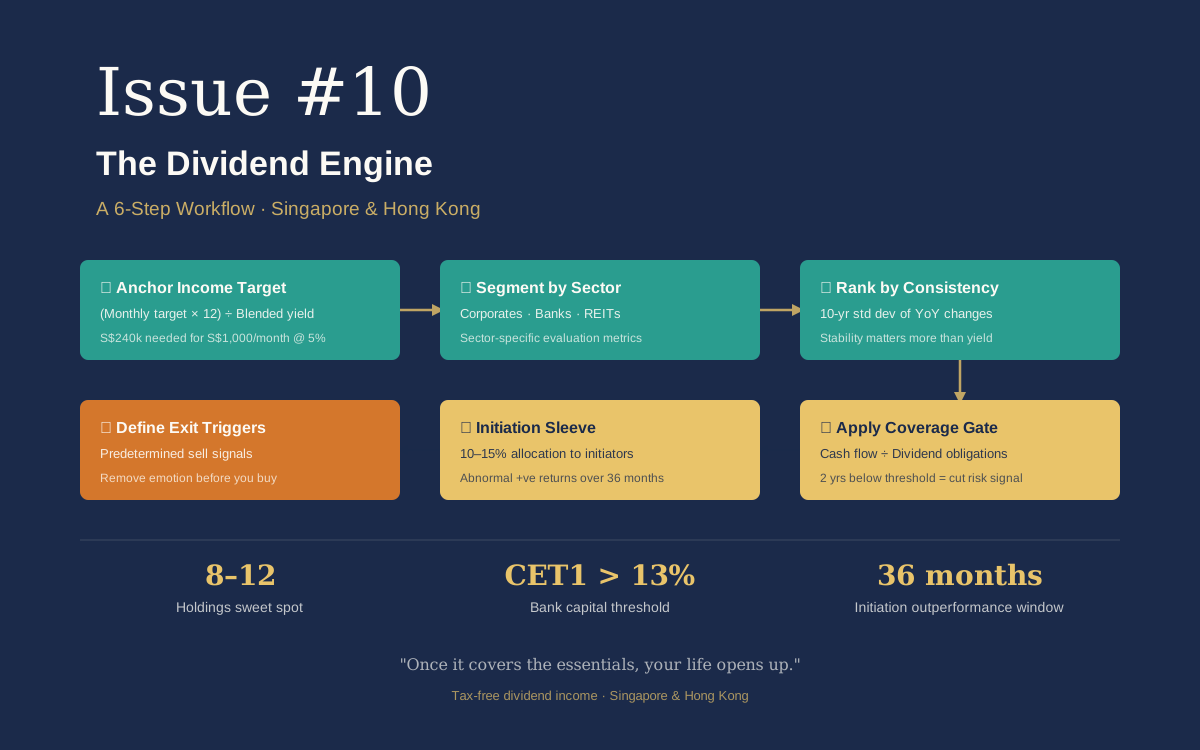
Issue #10 shifts from identifying and valuing individual businesses to building a portfolio that generates reliable income. The thesis is straightforward: a well-constructed dividend portfolio creates financial optionality. Once the income stream covers essential expenses, the calculus around work, time, and life choices changes materially. Singapore and Hong Kong investors have an additional structural advantage — neither jurisdiction taxes ordinary dividend income at the individual level, which means the compounding stays intact.
The issue opens with a capital anchoring exercise. The formula is simple: (monthly target × 12) ÷ blended portfolio yield. A target of S$1,000 per month at a 5% blended yield requires S$240,000 in capital. This arithmetic is deliberately front-loaded because it gives the portfolio a hard engineering constraint from the start, rather than accumulating holdings and hoping the income emerges.
Three historical failure modes frame what the workflow is designed to avoid. Screening for yield alone consistently leads investors into companies with deteriorating fundamentals — the 2020 suspension or reduction of dividends at HSBC, DBS, OCBC, and Singtel all followed periods when yield-focused investors had been buying on the way down. The second failure is applying identical metrics across different business models: what constitutes a healthy coverage ratio for a corporate issuer is entirely different from the capital adequacy framework that governs a bank. The third is the absence of exit criteria — most investors define entry rules in detail but leave sell decisions to emotion.
The bank assessment framework is a standalone contribution of this issue. Because banks generate revenue through net interest income rather than operating cash flows, EBIT-based coverage ratios are meaningless. Three Basel III metrics replace them: Common Equity Tier 1 above 13% (the regulatory shock absorber), NPL ratio consistently below 1.5% (credit quality signal), and cost-to-income below 45–50% (operational efficiency). These thresholds reflect the buffer levels that allowed Singapore’s banks to sustain dividends through the 2020 stress period, when less well-capitalised peers cut or suspended entirely.
The initiation sleeve — a 10–15% allocation to stocks that have recently initiated dividends for the first time — is grounded in the Michaely, Thaler & Womack (1995) research showing positive abnormal returns over the 36 months following initiation. The mechanism is a credible signal: committing to a dividend imposes fiscal discipline on management and communicates confidence in future cash flows. That signal tends to be underpriced at initiation and rerates as the market accumulates evidence of follow-through.
Portfolio concentration is set deliberately narrow: 8–12 holdings. This is tight enough to force conviction and require close monitoring of each position, but diversified enough across sectors that a single dividend cut does not critically impair the income stream.
The final step — defining exit triggers before entering a position — is arguably the most behaviourally important. Predetermined rules for exiting (coverage ratio falling below threshold for two consecutive years, dividend cut or suspension, CET1 falling below minimum, or sector fundamentals deteriorating) remove the need for in-the-moment judgement under stress. The decision is made once, in a calm state, before capital is deployed.
The framework is purpose-built for the Singapore and Hong Kong markets, where REITs, banks, and established corporates dominate the income landscape. But the underlying logic — anchoring on income, evaluating by asset class, prioritising consistency, monitoring coverage, and exiting on pre-defined rules — is portable wherever dividend income is the objective.
Keep reading