
Finding the Companies Worth Owning
ROE flatters companies that borrow to buy back shares. A five-factor quality screen using ROIC, gross profitability, FCF yield, revenue growth, and Piotroski F-Score finds the businesses that earn their returns rather than engineer them.
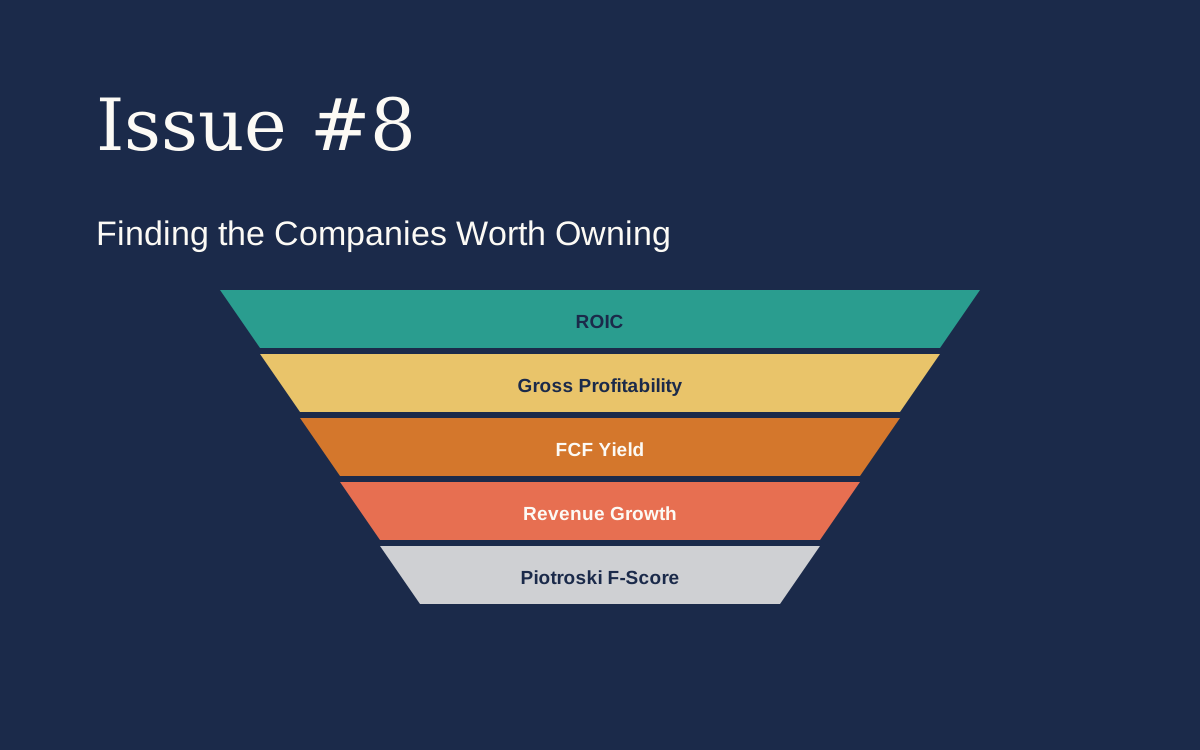
Issue #8 asks the most fundamental question in equity research: which companies are actually worth owning? The answer is not found in a single ratio but in a structured multi-factor screen that tests several dimensions of quality at once.
The issue opens by exposing a common distortion. ROE — return on equity — is the ratio most investors reach for first, but it rises mechanically when a company borrows money or reduces its share count through buybacks. Apple’s reported ROE exceeds 150% not because the business is three times stronger than NVIDIA, but because years of buybacks have reduced the equity base to near zero. ROIC, which measures return against the full capital deployed in the business, strips out that financial engineering and gives a cleaner signal.
From there, the screening framework stacks four additional dimensions. Gross profitability (gross profit scaled to assets) identifies businesses with durable pricing power. Free cash flow yield confirms that reported profits translate into real cash. Revenue growth screens for businesses still expanding, not merely harvesting a shrinking base. The Piotroski F-Score, a nine-point checklist of profitability, leverage, and efficiency signals, provides a final audit of financial health.
Running these five filters in sequence on a broad universe illustrates the funnel dynamic: many companies pass one test, far fewer pass all five. What remains is a short list of businesses that earn their returns rather than engineer them on paper.
The issue also addresses the integration problem. A quality screen identifies what to own; it does not tell you when to buy. The solution is to combine the fundamental output with the regime-aware technical signals introduced in the Issue #7 series. Strong businesses purchased at technically sound entry points offer a better risk-adjusted starting point than either screen applied in isolation.
Keep reading