
What's It Actually Worth?
Passing a quality screen is only half the answer — you still need to know what you're willing to pay. Three valuation frameworks (EPV, two-stage DCF, and a residual income model for banks) combine into a traffic-light signal that separates genuinely cheap companies from those that already price in perfection.
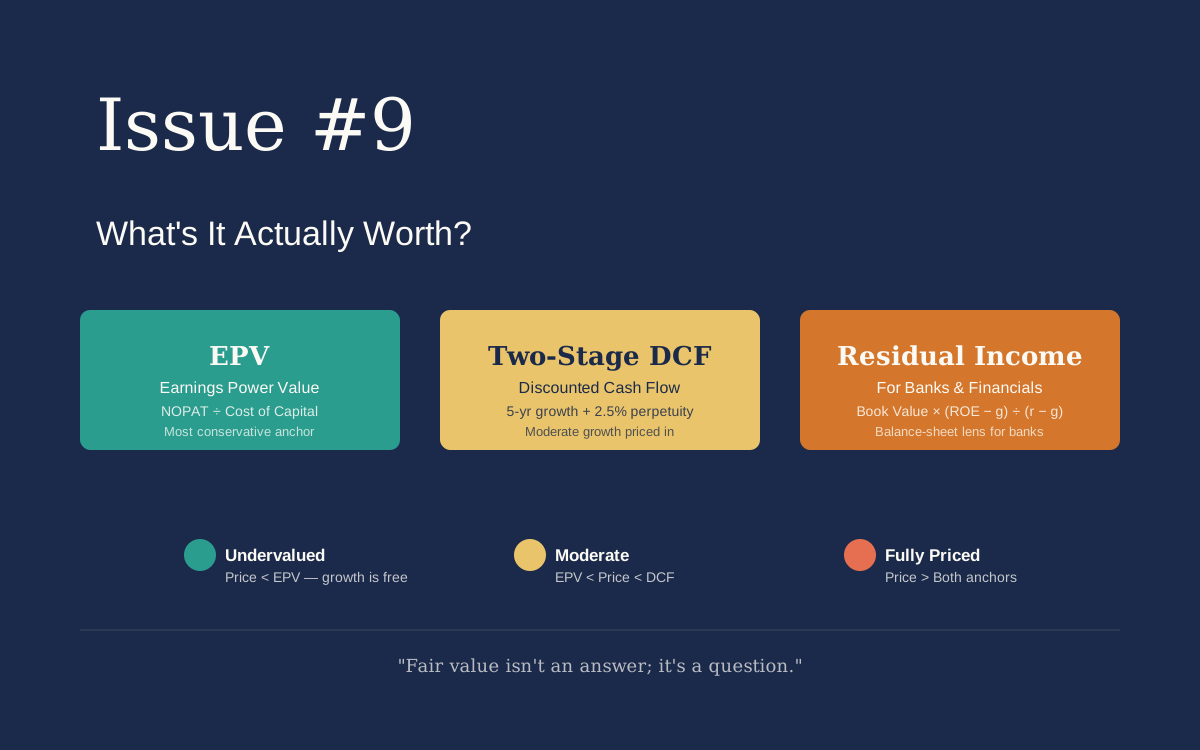
Issue #9 picks up where the quality screen left off. Finding businesses with strong ROIC, high gross profitability, and healthy Piotroski scores answers the question of what to own — but not what to pay. Two companies can pass identical filters and trade at very different multiples, reflecting entirely different assumptions about their future. Valuation is the discipline of making those assumptions explicit.
The issue introduces three frameworks matched to different business types. Earnings Power Value, drawn from Bruce Greenwald’s methodology, is the most conservative anchor. It divides normalised operating profit after tax by a uniform 10% cost of capital and asks a simple question: if this business never grows another dollar, is it still cheap? When the market price sits below EPV per share, investors are acquiring future growth at no additional cost. For businesses with stable EBIT and predictable capital expenditure, this is a powerful first filter.
Where EPV anchors the floor, the two-stage DCF extends the analysis to companies expected to grow. The model projects free cash flow over five years using recent revenue growth (capped at ±25%), applies a 2.5% perpetuity rate, and discounts everything at 10%. The resulting fair value represents the price at which investors are paying for growth but not overpaying for it. Crucially, the growth implied by the DCF is only worth having if ROIC exceeds the cost of capital; otherwise expansion destroys value.
Banks and financial institutions require a different lens entirely. Interest income is their core business, so EBIT is not a meaningful concept. The residual income model anchors valuation to book value and adjusts for the spread between ROE and growth: Fair Value = Book Value per share × (ROE − g) ÷ (r − g), using g = 3.5% and r = 10%. When applied to the major banks in the screened universe, five of the six appeared fully priced against this benchmark.
The three frameworks combine into a traffic-light signal. A green flag — price below EPV — means growth is essentially free. A yellow flag — price above EPV but below DCF — signals that the market is pricing in growth and the investment case depends on that growth materialising at a ROIC above the cost of capital. A red flag — price above both anchors — means the current price already reflects a best-case scenario with no margin of safety.
Running the signal across the 23-stock universe that survived the quality screen produced a sobering result: only two names, Bukit Sembawang and CCB, flashed green. Two others — SK Hynix and HKEX — sat in the yellow band. The remainder were fully priced. Quality and cheapness rarely coincide, and this exercise makes that trade-off visible rather than assumed.
The underlying lesson is philosophical as much as mechanical. Fair value is not a price target; it is a structured way of asking what you have to believe about a business to justify paying today’s price. A 1% shift in the discount rate moves EPV by 10–15%, which is reason enough to treat these models as tools for stress-testing assumptions rather than precise answers. The investor’s job is not to find the right number but to develop the habit of articulating the implicit bet embedded in every price they pay.
Keep reading